Showing posts with label media. Show all posts

Tuesday, 14 December 2010

My First Official Complaint

I have never sent an official complaint before. I moan about things, blog about things, but I have never felt the need to make an official statement before. Until now.

This interview went out on the BBC News channel yesterday:

As a result of this disgusting interview, trying blame Jody McIntyre for everything that happened whilst simultaneously trying to play down the event itself, I have sent the BBC this:

The appalling treatment of disabled protester Jody McIntyre

Protester Jody McIntyre was subjected to a disgustingly aggressive attack by presenter Ben Brown, rather than a fair and balanced interview, on the BBC News Channel, 13 December 2010.

The segment seems designed to throw as much suspicion as possible on Mr McIntyre, constantly questioning his involvement with the protests, which has little relevancy given the seriousness of the incident in question. After the first question, every query seems more concerned with Mr McIntyre's character than the very serious actions of the police force. Mr Brown asks about his previous political statements, which should have no bearing on the facts of the incident, and even asks, based on no evidence whatsoever, whether Mr McIntyre was throwing missiles at the police, clearly insinuating that Mr McIntyre somehow deserved his treatment.

That such suspicion should be thrown onto the victim of violent action -- and the footage shown clearly shows the incident, despite Mr Brown stressing that it would only "appear" to show this incident -- is appalling. It shows a bias towards the police force, despite the quite overwhelming evidence against them, and it is offensive that Mr Brown should try to imply that a protester somehow deserved to be thrown out of his wheelchair and dragged along a road. As such, I feel very strongly that this is unacceptable from the BBC.


It doesn't quite get across how strongly this interview disgusts me, but then, as I said, this is my first official complaint, and I felt that just repeating the word "bastards" as many times as would fit in the box would probably render my argument somewhat invalid.

Saturday, 11 December 2010

Policing the Police

Recently, I wrote about my displeasure at certain judicial decisions made in this country. But if we have learnt anything from the introduction to Law and Order: UK, in analysing justice,we should also look at the police force.

I would have thought the MSM's (Mainstream Media's) bias supporting the police force, rather than condemning it, was fairly apparent. Anton Vowl's piece here seems to sum up why that would be the case - that the authority of the police force would initially outweigh statements from the general public. Throughout Thursday's protests the only figures being relayed from Sky and BBC News were the number of police officers injured and protesters arrested -- no mention until much later of the number of protesters injured. The lack of relevance the MSM places on the wellbeing of protesters, many of whom were caught in the middle (if that is an important factor anyway), is highly troubling.

However, there is a lot of condemnation from the blogosphere, because time and time again police have been shown to be using needlessly brutal and thuggish tactics. But these are not groundless accusations. The case of Ian Tomlinson seems almost too obvious to mention, but the video footage shows clearly that he was walking away with his hands in his pockets when pushed, and regardless of whether or not this did cause his death (and it is my opinion that it probably did), this footage alone raises questions. More sickeningly, Lance Corporal Mark Aspinall was savagely beaten in a case of mistaken identity, yet only one of the three was successfully prosecuted.

These incidents are all at least few months old, but there have been so many during the recent protests. Take the case of Officer U1202, shown punching repeatedly into a crowd of students in a clearly unnecessary display of brutality. I doubt very much that the students suffering brain injuries as a result of being hit over the head with truncheons, or being pulled out of their wheelchairs would argue that they are more of a service than a force. The intimidating tactics, such as kettling or those deployed in Cambridge, only serve to make situations worse.

And charging with horses is wrong. These animals are large, fast and impossible to control entirely. The footage at London really is not as critical as it deserves, and the claims that this is the first time that this tactic has been used since the eighties are demonstrably false (despite what the Metropolitan Police would have you believe, with the official statements to the contrary).

The fact that the Metropolitan Police are happy to cover this up proves that it is not the purely the individual loose cannons that are the problem, but the organisation itself has questions to answer. Misrepresentation is everywhere, with very little being done to put it right. Were police officers "dragged off horses and beaten", as Cameron claims? No. Here the protesters are the "bad guys", and any incident must therefore been of their doing, whether it can be substantiated or not.

On the Today programme, the Met Commissioner praised the "restraint" of the firearms officers, suggesting that the shooting of protesters was an option, and only the moral judgements of individual officers saved bloodshed. This statement seems entirely contrary to the argument that it is the individuals who go wrong, whilst the force (or service) maintains the peace.

Time and again the police have shown these brutish tactics. The citations in this post are the most concrete evidence I could find of problems with the police, but the twitter feeds and live blogs from within kettles, or on the streets, go further still. I am glad that blind faith in the police is down, and if they really want our trust, then, like anybody or anything else, they must earn it.

This blog has been adapted from a comment left in response to this post. This comment is currently awaiting modification
Monday, 1 November 2010

Why, Stephen Fry, WHY?

I consider myself a normal person (pretty much). And like every other normal person I love Stephen Fry. His wordiness, his wit and his intellect have often left me amazed. In fact, in my last blog post I asked whether it was "possible to describe anything Stephen Fry has done as anything other than wonderful?". Sadly, it seems that this might almost have been a challenge.

In case you are unaware, Fry was interviewed for Attitude magazine, and made a series of comments suggesting women did not enjoy sex, but "that sex is the price they are willing to pay for a relationship with a man, which is what they want." When these comments were picked up by The Guardian on Sunday, there was naturally a huge commotion on Twitter, amongst other places.

Fry claims to have been misquoted by the Guardian, saying
"So some fucking paper misquotes a humorous interview I gave, which itself misquoted me and now I'm the Antichrist. I give up."
Since then, he has tweeted once more -- "Bye, bye" -- and so, worryingly, looks like he may be about to leave Twitter, which would be a terrible shame for one of the most popular tweeters out there.

I have found the whole situation to be incredibly confusing and disheartening. Fry has not earned the "National Treasure" badge by accident, but by being one of the most likable and warm public figures in the country. These comments seem so out of character, so naturally I would hope that he has been misquoted, as I'm sure would so many people.

But Fry doesn't seem to be using Twitter as he said he could. One of the benefits of the social networking site is that it enables you to clarify your position without having to be filtered through the journalists who can twist your words to suit their own agendas. When the Mail accused him of leading an "Atheist Hate Campaign", he neatly demonstrated this to be false in his blog, and was able to put across what he actually believed.

Slightly more problematic in this regard is that Fry himself tweeted a link to a website with extracts from the interview himself (I believe it was this one), but has since deleted that tweet. Certainly, this article contains contentious quotes, so it seems less likely that The Guardian has entirely misrepresented his case, leaving one to wonder why he would initially tweet the link, then remove it after he claims to have been misquoted? (For what it's worth, I had this on my Tumblr the day before The Guardian ran with the story, and it's contents are such I don't feel I need to argue Fry's point again here.) He also seems to have made similar comments in a previous interview, which can be found on YouTube here.

The curious thing I have found is that some defenders of Stephen Fry are so ready to criticise The Guardian for misquoting the interview without looking into any other sources to see what the interview said. Of course, it's still possible that his intentions have been misread, and I would dearly love this to be the case, but to blindly assume that someone is right just because they're Stephen Fry is wrong.

I have focused on this more than most stories of this nature. Had it been almost any other figure, I probably would have made some remark and passed over it, but Fry is different. His charm has won so many people over, including me, and his intellect is so great that it's often easy to forget that he is fallible, and so devastating when proved so. But I hope that Fry rejoins Twitter, takes the time to clarify his statements, point out where he's been misquoted, and that this issue can be left behind very soon.

Thursday, 9 September 2010

Ad Priorities

I am, it is fairly safe to say, not a fan of advertising. In fact, I usually find it shallow, depressing and repetitive. I've already blogged generally about LGBT issues and advertising, and often refer to Charlie Brooker's excellent Screenwipe on advertising (on YouTube in three parts here, here and here). But the other day I saw an ad which annoyed, frustrated and depressed me more than a thousand "Go Compare" singers ever could.


Yes, if there was ever any doubt, beauty is entirely skin deep. But it doesn't stop at that, because happiness is directly proportional to how attractive you are. And, of course, we can make you more attractive. All it takes is to lop a bit off here, suck a bit out of there, and Hey Presto! You now conform to everything you've been told is beautiful, because that's the only beauty there is!

This is nothing new in advertising. Every advert for a beauty product suggests that, by using it, you can become a happier or more popular person. But this one is remarkably upfront, about something so incredibly drastic, and it's hard not to worry about the repercussions of an industry which finds this permissible. The token male doesn't detract from the heavy-handedness of it either.

Women seem to get the worse end of the deal whichever gender the advert is aimed at. Men's adverts have always used sexual images to promote their products, equating semi-naked women with everything from deodorant to video games(once rather tactlessly described by someone I knew as suggesting a "Buy One Get One Free" deal). Yet adverts aimed at women promote stick-thin models as an ideal that you SHOULD be living up to.

I don't know how long this cosmetic surgery advert has been showing, how often it has been seen, or even if it has attracted any complaints. I caught it one evening on some digital channel. However, I was aware of a storm of complaints around this advert:


So this advert is offensive? All it seems to offer is some images of women in contemplation, then a web address which offers more information. The word "abortion" is not even mentioned in the advert, let alone depicted or promoted. The ASA recognised this, concluding that:
...the ad was for an advice service for women dealing with an unplanned pregnancy, and stated that Marie Stopes could help women who were 'pregnant and not sure what to do'. We considered it was an ad for a general pregnancy advice service for women who wished to learn about and discuss their options, which might include, but were not limited to, abortion.


Yet still the mainstream media focus on the complaints this advert receives, and so instead of offering women the information and choices they may need, we're left with identical women obsessing on hair, make-up and pro-biotic yoghurt.

Bryant v Burley


There is always the danger, when you have an opinion, of allowing that opinion to influence your viewpoint. For instance, I think that Rupert Murdoch and his affiliated publications are hideously biased politically towards a side I disagree with. I know that the News of the World, one of those publications, is currently under scrutiny thanks to allegations of phone-hacking. I also know that Sky News is, in part, owned by Murdoch.

All this leaves me open to the suggestion that Sky News would provide poor coverage of this story. Indeed, they, along with most of the mainstream media, provided no coverage of it the day The Guardian broke the story, and only relented when it became too big to deny. But, as Kay Burley points out in the clip, as a journalist she is there to provide the opposite side of the argument. It is only that she performs this badly that it is worthy of criticism.

The first problem is her demand for evidence. This is normally a perfectly reasonable demand, except for the fact that all the evidence has been out in public for a while (see Jack of Kent's blogpost for details), and, as an interviewee, it's a little unfair to ask him for all the figures when he doesn't have them to hand.

Nevertheless, the interview then progresses. Burley asks Bryant if he is prepared to make a controversial claim. A claim that he had already made before he was interrupted by Burley asking for evidence. If nothing else, it's poor journalism to ask an interviewee merely to repeat the same point over and over again.

Since Paxman's famous interview with Michael Howard, in which he continued to ask if Howard the same question without getting a straight answer, it seems that all journalists think they can badger their way to the truth. Burley is not alone in this, and neither is it limited to politics. Fabio Capello was badgered by a journalist minutes after England's draw with the USA in the FIFA World Cup as to the future of goalkeeper Robert Green. When Capello rightly argued it was too early to make a firm decision, the point continued to be brought up.

The biggest problem with Burley's "Devil's Advocate" argument is that she tries to make a dismissive comment without phrasing it as a question. Her assertion that Bryant should merely change his PIN and there would be no problem is immediately countered, despite the fact that she was clearly trying to move on to another topic. Of course, the fact that she seemed to be defending the concept of phone-hacking itself, rather than the fact that these are just allegations, is also disturbing.

So, is it journalistic bias, or just being "dim"? It's difficult to say objectively. However, whichever is the case, it's not the first time that Kay Burley has shown herself to be astonishingly poor at conducting an interview. If only there could have been protesters behind this interview...

Tuesday, 10 August 2010

Infringement State of Mind

If you're reading this then that probably means you have an internet connection. And if you do, then you may well have watched a video spoofing the song "Empire State of Mind" by Jay-Z and Alicia Keys, but setting it in Newport. It was well written, well executed, and consequently gained over two and a half million hits on YouTube.

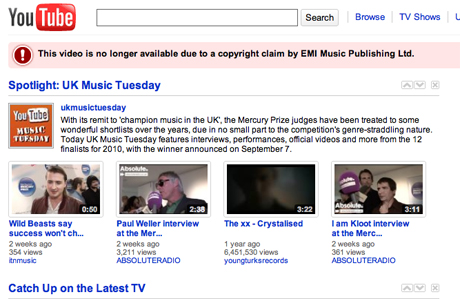
Here is what you see if you search for it now:

Yes, EMI decided that it was infringing on their copyright.

Now, I am not against copyrighting material. Artists have to earn money like everyone else, and if you want well produced music or films, someone somewhere has to pay for it. I would actually quite like to see The Times's paywall succeed, even though its content is not for me, and, I would argue, their pricing is questionable. But this EMI claim is something different.

The question is simple: is this song contributing to a loss of revenue for EMI? I would find it hard to believe that a video placed free on YouTube is a replacement for the original song. Although I don't have any figures to back this up, I would imagine that very few people may have been about to buy the original track, then decided that they would stick with this YouTube spoof instead.

In fact, I would go further than that. When I first heard the spoof, I thought it was clever, funny and brilliant, and immediately went over to the original song's video to compare, instantly giving EMI the income from that play (which I know is tiny, but unexpected profit, nonetheless). My interest rekindled, I almost bought the track, and I'm sure many did. All this, despite the fact that I'd got pretty fed up with it when it came out however many months before.

It used to be that if you were to mention, say, Jeff's Chip Shop on the television, Jeff would be so thrilled with the free publicity that you'd get a free portion of chips (I may be stretching this whole "chip" thing). Following EMI's example, Jeff would presumably demand that the tapes be destroyed and never brought up again.

The whole thing is exactly like the Downfall "Hitler reacts" case. Companies have become so paranoid by people stealing their material that they think anyone using it is infringing on their copyright. EMI are perfectly justified legally in what they are doing, but they've missed the point entirely, and not only are they taking away a highly successful, completely unpaid for advert for their product, but they are making themselves look like petty destroyers of creativity. With that kind of public image, it's only going to be easier for people to morally justify why they're happy to illegally download whole albums. For an industry apparently obsessed with image, they are, if nothing else, showing a remarkable lack of public awareness.

UPDATE, 11/08/10: Looks like this take isn't quite fair. According to a Guardian report today, it's the songwriters who opposed to the video, not EMI itself. The arguments stand though: what possible loss of revenue does it lead to? Is the notion of Llanfairpwllgwyngyllgogerychwyrndrobwllllantysiliogogogoch so abhorrent to you that you don't want it associated with your song? As artists, do you not at least appreciate the skill of adapting lyrics? I know that you have every legal right, but you have singularly failed to take advantage of a situation based on an infatuation with ownership, and to me that is just idiocy.

Wednesday, 7 July 2010

Pie in the Sky

Hello all,


A couple of months ago I posted a tweet on my Twitter page (which I'm shamelessly linking to here), saying,
People want to sack Kay Burley. People are laughing at Adam Boulton. Sky - When you BECOME the news, you're doing it wrong.


This immediately became the most re-tweeted tweet I'd ever posted, implying that other people, like me, were also fed up with Sky "News"'s take on events at that time. More than 1000 people complained to Ofcom about the clash involving Boulton above, and a further 1000-odd complained about Kay Burley's shocking "interview" with a protester:

(Though this did lead to this fantastic moment, in which the protesters made their opinions of Sky News very clear).

This kind of "news" coverage (the inverted commas are getting tedious, so I shall stop, but you get the idea) is quite common in America, where pundits like Bill O'Reilly and the monstrous Glenn Beck have made their names by being bullies dressed up as journalists. There is no attempt to dress the news as anything other than propaganda, and as a result, gaining facts is a tricky business. But in this country, mainstream broadcasters must be impartial, and our news is the better for it.

Some important facts must be added at this point, that may or may not have relevance. Sky News is, ultimately, owned by Rupert Murdoch, at that time a prominent supporter of David Cameron and the Conservative Party, who owns many newspapers who proclaimed their support publicly in the run-up to the General Election. He also owns FOX News, the home of O'Reilly, Beck, and many of the most significant right-wing propagandists currently working in America. His son, James Murdoch, is the direct head of News Corp's dealings in Europe, and is non-executive chairman at BSkyB. He is also the main reason for Murdoch Snr's switch from Brown to Cameron. This information might lead us to assume a bias is likely, BUT it does not make it inevitable.

I was disappointed when Ofcom decided to reject the complaints leveled at Sky News. For me, both of these incidents show clear journalistic bias. David Babbs, the director of the movement behind the protest, seems barely able to speak three words before Burley shouts at his pointlessness and tells him to go home and watch it all on Sky News (nice plug, there, Kay). And at what point did anyone vote for a "Hung Parliament"? The only people claiming you could actively vote for a Hung Parliament were the Conservatives, though I would argue this is more an inability to grasp facts rather than a deliberate link. However, it is, whichever way you look at it, shockingly poor journalism.

Boulton's outbreak is less serious than Kay Burley's crimes, if much funnier. It weakens your integrity as a journalist if you are unable to counter arguments with anything other than shouting (rather like John Sweeney getting angry at the Church of Scientology), and so again can only be seen as bad journalism. His constant point-scoring techniques make him sound more like one of the politicians he interviews than an impartial onlooker. Even if we accept that, as an interviewer, he must take the other side of the argument, it is clear from the footage that he is trying to undermine Alastair Campbell's arguments, rather than challenge or highlight them.

If Ofcom are not going to censure such poor journalism and partial broadcasting, there remains only one solution. As the protesters themselves shouted out on Sky television, "Watch the BBC"!

Sunday, 4 July 2010

Pride (In The Name Of Love)

Hello all,

This weekend has seen the annual Pride events held in London. As usual (though in reassuringly small numbers), people took to the internet asking why there is no "Straight Pride" event, in a way that reminds me of the time when I asked my mother why there was a Mothers' Day and Fathers' Day, but no Children's Day. Her reply was that that was every other day of the year, and with LGBT rights this certainly is the case.

The LGBT community is, of course, served badly by the media in most of its forms (popular literature, music, film and television etc.), but there is one area that has consistently underrepresented it, and in my opinion will continue to do so: marketing.

Little seems to have changed since this article was written two years ago. Gay men often seem notable by their absence, and women even less so. Why is this? When Maltesers made the original version of this advert, it featured a gay couple, but it was decided that this limited the market to just gay men. On that logic, of course, no-one in the LGBT community would be able to buy anything. This advert features two pregnant women, but it would be incredible to claim that it would limit the market to just pregnant women, so I do not see how this idea holds. I, despite being a heterosexual male, buy Galaxy chocolate, but not Yorkie bars, and I am sure I am far from the exception.

I don't believe that this situation is likely to improve very soon. Charlie Brooker's Screenwipe showed the difficulties that globalisation has introduced to marketing (6:30 into this video), focusing on the casual racism of the industry, but clearly affecting the representation of LGBT people. The medium must be inherently conservative to appeal to the largest number of people, but its prevalence it propagates the society it is trying to reflect.

Of course, I am aware that it is not the advertisers who are homophobic, racist, misogynistic or anything else. If it turned out that they could make more money featuring homosexual couples in their adverts, they'd start today. It's a nasty system, and one can't help sympathise with Bill Hicks in his classic rant on marketing.

Wednesday, 23 June 2010

To be a spoil-sport, or not?

Hello all,

Today, I find myself in a very peculiar position. For the past five hours or so I have been watching, almost solidly, sport. As a cricket fan, this in itself is not unprecedented, except for the fact that I can't really claim to like either of the sports I have been watching. The England vs Slovenia football match seemed to be an average game from my limited knowledge of the sport, whereas the current Isner/Mahut game of tennis (that, as it is still going, I have no link for, save to say it is the longest game in Wimbledon history) is as exciting as watching a fish swim excitedly back and forth in an aquarium for about three hours.

And yet, I am still watching it, hypnotised. Why? There are plenty of people who hold as little interest in football as me who become even less interested during major events like the World Cup, people whose opinions I respect and admire. Caitlin, a friend of mine (who you can follow on twitter here) recently started a discussion of her Facebook page by claiming:
When it can be front page news when there's actual real things happening that are being ignored, that's wrong.

and it's pretty hard to argue with that. By all rights, I should be blogging about Obama firing General McChrystal or passing comment on the Budget, but these things are not getting discussed in the same way.

The truth is that sport means a lot to a lot of people. I don't even think it would be too controversial to claim that many people value their sporting team or hero above any religion they may or may not have, and it certainly unites people, as seen, it was pointed out, in the film Invictus. An even more powerful example, perhaps, might have been the Christmas Day football match during World War One. I would argue that this gives it a significance that cannot merely be swept under the carpet, and that having a basic idea of events (but not necessarily an in-depth knowledge) is almost as important as having a grasp on other news stories.

The more problematic issue, and I think the one that I think Caitlin was referring to, was the coverage these events receive. Newspapers are always going to appeal to the broadest possible audience with their front pages, but the television coverage is ubiquitous. Now that the Digital Switchover is rolling out, more and more homes have multiple channels, including many with sports-channel packages, yet today, BBC1, BBC2 and ITV1 have devoted a HUGE amount of time towards covering the sport. Who should be expected to move: sports fans, or non-sports fans. Personally I feel that major sporting events, such as an England football match, do have the right to elbow out a repeat of Bargain Hunt, but since the coverage of the World Cup has put all games played on one of the major television networks (BBC1 or ITV1), which, to my mind, is excessive. However, it is something that I am willing to put up with. Provided it does not interfere with Doctor Who.

Yes, major sport stars are overpaid, their skills vastly overvalued by a society that considers celebrity the ideal (and those two worlds collided in this spectacular non-story). They provide easy hate-figures in a world too full of real villains. But to celebrate one's ignorance of anything, be it sport, politics, or even engineering, is never, to my mind, the right way to go.

Wednesday, 5 May 2010

Violence is always funny, as long as it's against women!


Hello all,

Today I have, like a great deal of other people, been moved to great anger by an article published in ZOO Magazine (that links to the homepage of the magazine itself, so probably best not to click on it if you're in work. Or anywhere, really, but it gives you a flavour of the magazine in question). As I have been tweeting about it for a while, anyone following me may find some of this a bit familiar, but the remarks are intolerable.

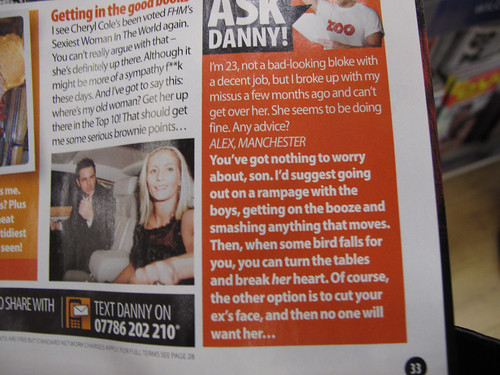
The offending article is Danny Dyer's Agony Uncle page, which offered some unusual advice to a man who had recently split up with his girlfriend. In fact, Dyer suggested that he could "cut [his] ex's face, and then no one will want her"! Naturally, this remark produced an enormous uproar amongst people who found this "joke" distasteful, and ZOO were forced to issue an unreserved apology.

The apology, as I'm sure you will have seen by now, is a joke. The description of its publication as a "regrettable publication error" makes it sound as if these remarks were slipped in by something completely unbeknown to them. Perhaps the presses that published the magazines are planning to overturn their cruel overlords? It should have been spotted by the editors, and they should have removed it. Perhaps the error was publishing it in the first place.

This is presumably not the first "publication error" either, if this column is anything to go by. Granted, the fact that the image is more fantastic does not make it as unpleasant as his most recent suggestion, but this does not detract from the fact that he seems to take great joy in coming up with these suggestions. I don't believe for one moment that he would act, or expect anyone to act, on his "humorous advice", but there remains a leery, lad-ish tone more reminiscent of the 1970s than the 2010s.

Unsurprisingly, there have been people claiming that anyone complaining about this joke is missing the point, and that the statement is meant ironically. But irony will only work if it is transparent. Jimmy Carr's humour is offensive, but his delivery is so staged, coupled with the fact that his off-stage persona is so well known, that the intentions are self-evident. The title of this very blog is ironic, and yet I felt that the tone of this was so apparent that it too would be obvious. Dyer's column is the opposite, so that you could never truly claim that his vile comments weren't in keeping with the rest of the piece.

Dyer himself seems not to grasp the concept of irony. During an episode of "You Have Been Watching" last year, Charlie Brooker and panelists, including Frankie Boyle, discussed an episode of Dyer's Bravo show in which he was punched in the face. After mockingly mentioning that some of them would have liked a go, Dyer published an article in his column announcing he was quitting TV after the ridiculing he received. Clearly, when the humour is turned on him, he finds it far less funny.

Finally, there is a serious side to this. Domestic abuse affects, as we all know, hundreds of thousands of women a year. To make light of this situation is to do it an incredible injustice, and yet instances of this happening seem to be swept under the carpet. Today is the birthday of singer Chris Brown, convicted of assault against his then-girlfriend Rihanna. Whilst criticism of the ZOO article was trending on twitter, people wishing him a Happy Birthday was trending far higher. There is still, it seems, a long way to go before the issue of domestic violence is even close to being resolved.